
Busting noise barriers and scoring privacy goals – that’s the name of the game when it comes to picking the right fence for your Perth pad. You’re after that sweet spot where your backyard feels like a quiet hideaway, not a front-row seat to every lawnmower and highway roar.
In this guide, I’ll walk you through what makes an acoustic fence different from your everyday backyard fence, weigh up the costs, and explain who should pick which. You’ll get real-talk tips (no jargon, promise) on noise-blocking, privacy gains, and even local rules. By the end, you’ll know if a fortress-like sound wall or a classic picket fence is the best choice for your property. Let’s get into it!
When most folks say “fence,” they picture a standard backyard barrier – think timber pales, Colorbond steel, or vinyl panels. These privacy fences are built to keep prying eyes out of your yard, and they do offer some noise dampening.
For example, a 1.8m high timber fence blocks maybe 10–15 dB of sound; that’s like turning your radio down a bit. You’ll notice it softens everyday racket (chatty neighbours, barking dogs, lawnmowers) but won’t totally hush freeway rumble.
Ordinary fences come in all styles: warm wood looks, sleek coloured steel, or easy-care PVC. They’re generally lighter and cheaper – say, around $100–150 per metre for Colorbond. Many Perth homeowners even DIY these, slapping up panels over a weekend.
A simple chain-link fence gives almost zero privacy or noise reduction. Solid panels work much better at quieting the yard.
Of course, not all normal fences are equal. A bare chain-link or slatted picket fence might as well be invisible to sound – noise just sails right through. Even a standard wood paling fence only mutes mid-range noises, not the deep bass of trucks or loud parties.
And since councils in WA typically cap fence heights to about 1.8 m (1.2 m on road-facing sides) without approvals, you’re limited in how high you can go. Higher is better for blocking sound, so ordinary fences have a hard ceiling.
Why Choose an Acoustic Fence?
Now, imagine taking that solid fence and supercharging it for silence. Enter the acoustic fence – essentially a science-grade noise barrier. These beasts are engineered specifically for sound control.
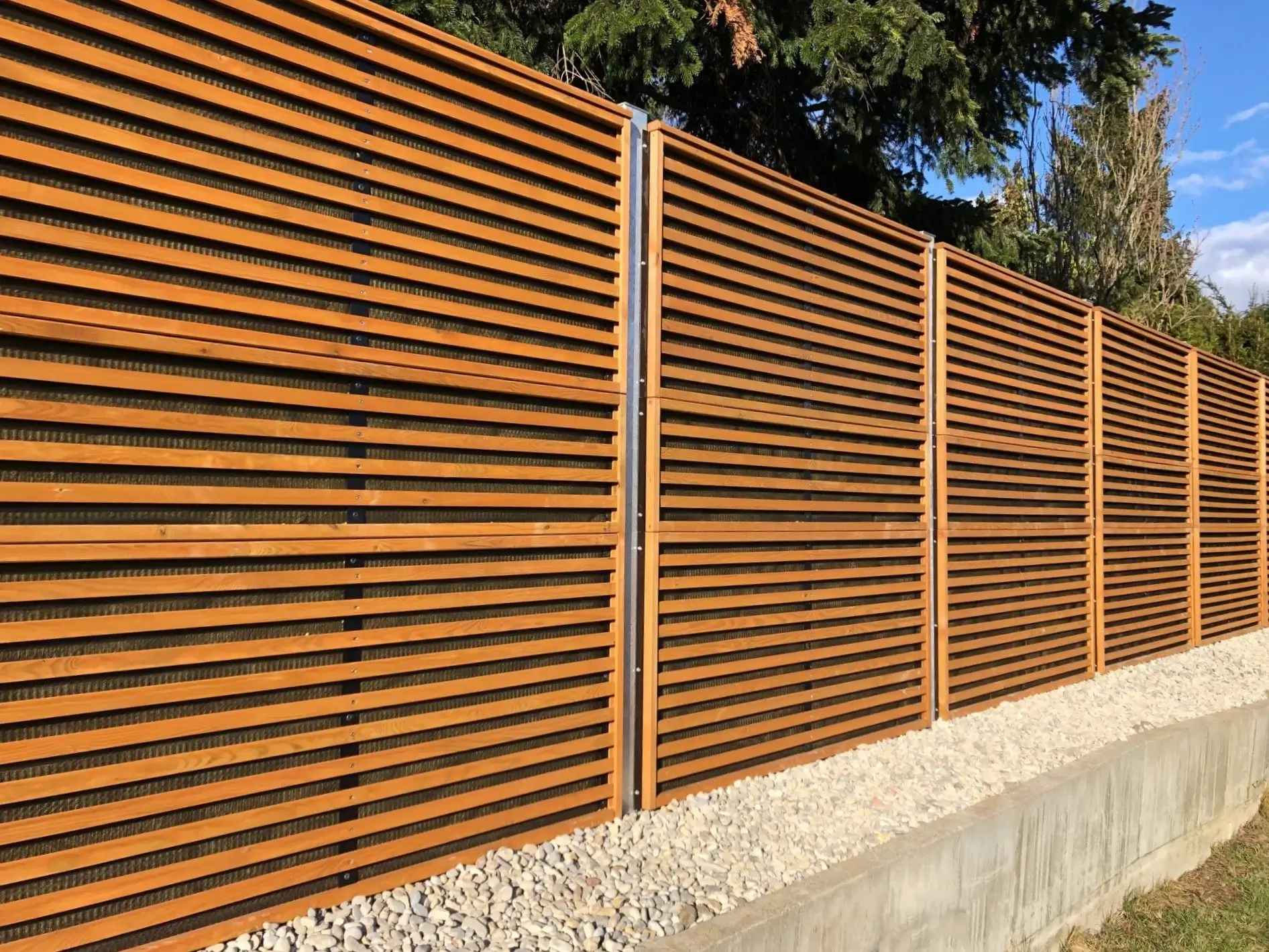
Think double-layer panels (metal–foam–metal “sandwiches”), extra-thick timber boards, or even precast concrete walls. A key trick is mass: a heavy fence absorbs and deflects sound instead of letting it poke through.
A quality acoustic panel can weigh 4–5 times more per square metre than a normal fence sheet. For comparison, ordinary Colorbond might be 3–5 kg/m², while an acoustic composite panel can be 15–20 kg/m².
That extra heft and insulation can slash 20–30 dB or more – meaning traffic noise can end up only one-quarter as loud as before. No surprise, these soundproof walls are what you see along highways or shielding stadiums.
Building one of these isn’t a weekend DIY project. The panels are heavy, and installation demands perfect seals (even a tiny gap can leak sound like a pinhole). Most acoustic fences are installed by pros with specialised gear – definitely worth chatting with an acoustic fence installer if you’re serious about quiet.
In Perth’s hot, salty climate, these fences often use corrosion-proof and even bushfire-resilient materials (galvanised steel frames, concrete panels, etc.). They usually max out at the legal limit (roughly 2.1 m) unless a special permit is obtained. Visually, they tend to look like solid walls: modern concrete finishes or composite boards, more bunker than garden gate.
Acoustic fences are the heavy artillery for noise. They’re pricier (panels and installation can run double or triple normal fences) but deliver real peace. If your house backs onto a freeway, train line, or rowdy industrial estate, these might be the only thing that keeps your yard livable.
Side-by-Side Comparison
Let’s cut to the chase. Here’s how a normal privacy fence and an acoustic fence typically stack up:
| Aspect | Normal “Privacy” Fence | Acoustic Fence |
|---|---|---|
| Materials | Timber palings, standard Colorbond steel, or vinyl. Light panels (~3–6 kg/m²). | Dense, heavy stuff: thick pine or composite boards (~12–20 kg/m²), double steel-foam panels, precast concrete. |
| Noise reduction | Moderate (~10–20 dB). Softens everyday sounds (kids playing, TVs, dogs). | High (~20–30+ dB). Blocks deep rumble – trucks, trains – dramatically. |
| Height (Perth) | Typically up to ~1.8 m (max 2.1 m with permit). | Usually same legal limit (often built to 2.1–2.4 m; some permits for 3 m+). |
| Cost | Lower: basic Colorbond ~A$100–130/m, timber ~100–150/m installed. | Higher: specialized panels, lining, pro labour. Often 2–3x normal price per metre. |
| Installation | Straightforward. Many DIY-friendly or local tradies. | Professional job only. Heavy panels need cranes or lifts and exacting fit. |
| Privacy | Good visual privacy (solid panels). | Excellent privacy (solid “wall”); also stops sound. |
| Appearance | Variety: wood warmth or sleek steel, lots of colour choices. | Wall-like look. Limited styles (e.g. concrete, plain panels), but modern finishes available. |
| Maintenance | Medium: wood may need staining/repairs; metal may need painting if scratched. | Low: steel or concrete resists rot and warping; long warranties. |
| Best use | Typical suburban yards, moderate noise (chatty neighbours, lawnmowers). | Noisy situations (busy road frontage, adjacent to industrial or entertainment areas). |
Table: Comparing privacy fences vs acoustic fences for noise blocking and privacy. Acoustic fences trade extra cost for a major jump in quiet and durability. Even a 10 dB improvement cuts perceived noise in half, so the jump from ~15 dB to ~25 dB is a night-and-day difference in a backyard.
Cost and Budgets
Money talks, especially when a solid wall of silence might break the bank. Generally, a basic privacy fence will cost you less per metre. In Perth, expect about A$100–150/m for a standard 1.8m-tall Colorbond or pine paling fence (materials + install). You might even snag bargains if you DIY part of it. Add a sealant or inner lining for extra quiet, and still it’s relatively cheap.
Acoustic fencing is more like a premium renovation. When you start adding double panels, mass-loaded vinyl, or concrete, prices can easily double or triple. Some timber acoustic panels are quoted around A$250–400 per metre installed, while high-end composite or steel systems run upwards of A$350–500 per metre.
These are ballpark: the total depends on height, length, and accessibility. Labor is higher too; expect installers to take extra care sealing every gap. In short, budget at least 2× the cost of a normal fence if you’re serious about acoustics.
However, remember: this is an investment in quality of life (and even property value). A quiet outdoor space can be a real draw for buyers. If your budget is tight and the noise is only moderate, a solid wooden or Colorbond fence might suffice. But for serious noise, many Perth homeowners see it as worth spending up-front for peace and calm later.
Privacy and Aesthetics
All solid fences give you private eyes-only access to your yard. A normal timber or Colorbond fence looks good in the garden and matches Aussie backyards, blending with greenery. You can choose a warm wood stain or one of 20 steel colours.
Acoustic fences, by comparison, look more like mini fortresses: thick panels or concrete slabs with few gaps. They’re not about curb appeal, but manufacturers do offer finishes (textured, wood-grain cladding, colours) to help.
Witty side note: thick curtains vs pinholes. A chain-link or slatted fence is like curtains with holes – you can see (and hear) right through. A privacy fence is more like heavy drapes – you’re visually screened and some sound is muffled. An acoustic fence is like soundproof blackout curtains – it turns your yard into a quiet room.
One trick for normal fences: layer on privacy screening. You might add vines, bamboo screens, or lattice with creepers. That helps eyes and softens noise slightly, but it’s an add-on, not a full solution. The government even notes that plants can help scattering sound, but they won’t replace a solid barrier. Think of greenery as padding behind your main wall.
Noise Reduction Explained
What does, say, 20 dB of noise reduction really mean? Humans perceive sound logarithmically: roughly, every 10 dB cut is about half as loud. So a 20 dB cut makes it four times quieter. Even a 10–15 dB gain (possible with a stout timber fence) is noticeable. But jumping up to 25–30 dB (with acoustic fencing) is massive – normal kids’ chatter or traffic hum becomes a faint background whisper.
How do acoustic fences pull this off? Three big factors: height, mass, and sealing. Taller fences catch more sound (if you can see the noise source, the sound travels there too). That’s why experts often recommend at least 2.4m height for major road noise – though Perth laws might need special approval above 2.1m.
More mass means more sound energy gets absorbed or bounced away – hence those 15–20 kg/m² panels vs the 3–5 kg of a normal sheet. And every crack or gap is a sound leak, so acoustic installations meticulously seal posts, overlaps and the top line.
A quick analogy: think of sound like light. If you can see the street through a fence, sound will find that path too. Acoustic fences are a continuous “wall of night” – no straight-line to the source. Practical tip: if you have an acoustic fence, don’t skimp on filling holes or the bottom edge – even leaving it 5 cm off the ground can let noise sneak in from below.
Perth Considerations: Weather & Rules
You’d be silly to forget Perth’s unique climate. Intense sun, salt-laden breezes (if near the coast) and occasional bushfire risk all play into fence choice. Colourbond steel is a top pick in WA – it won’t warp, rust easily, or burn. Many acoustic panels use galvanised steel or concrete too, which stand up well to our conditions. In contrast, untreated timber fences can crack or get eaten by rot faster here.
On the legal front, know your limits. Western Australia’s fencing rules (Dividing Fences Act) generally cap boundary fences at 1.8 m without approval. Front (street-facing) fences often must be even lower (around 1.2 m) for visibility. If you want to go higher – and an acoustic fence often pushes that limit – you’ll need council approval.
The WA government and local councils are pretty clear about this. My advice: plan that paperwork from the start. It’s no fun to install a fence and then be told to take it down because it’s too tall.
One more Perth tip: consider the view. An acoustic fence can be a visual blocker too (though it’s all-solid). If you love your sunrise vista or skyline sightlines, you might not want a 3m wall on that side. But if peace is priority, it could be worth it. And remember, you can landscape in front of it with vines or shrubs to soften the look (just don’t expect those plants to replace the sound block).
Installation & Maintenance
Putting up fences is usually quick. A standard 20m wood fence can be done in a day by pros (or a lawn-averse Sunday DIY project). An acoustic fence, however, is more involved.
Posts need heavy concrete footing, panels may require cranes or at least two strong guys, and you have to get every joint perfect. Expect an acoustic install to take a few days (depending on length) and involve gear – you’ll see installers using sealant guns and foam strips everywhere.
Maintenance is where acoustic fences shine. Because they’re often steel or concrete, there’s little to do: maybe hose off dust or repaint a scratched panel eventually. No warping boards or termites nibbling at them.
A regular wood fence, by contrast, might need annual check-ups: tight down stray nails, replace warped planks, fresh paint/stain every few years. If you’re after low fuss, a metal acoustic fence scores points here.
Making the Right Choice
So – is an acoustic fence right for you, or should you stick with a regular one? It boils down to noise level vs budget. If you’ve got a mild case of neighbour chatter or street hum, a sturdy Colorbond fence (with good seals) can curb most of that for a modest price. But if your backyard drama is dominated by freeways, nightclubs, industrial noise or constant building work next door, you might just need the big guns.
Acoustic fencing is an investment, but it’s one that can transform your living experience. Many people I’ve met literally said their yard felt like a different place after. It also tends to add resale appeal: peace sells as well as space does.
On the other hand, don’t overspend if your ear isn’t burning. Sometimes a cheaper fence plus white-noise (like a fountain or wind chimes) is plenty.
Last word of advice: Ask an installer. Fence experts have seen what works here in Perth. They’ll size up your site, factor in dirt levels, and might even have a site meter to gauge noise. Chatting with an acoustic fence installer (like the link below) can give you clarity on what type of fence will solve your problem without emptying your wallet.
Ready to quiet down your life? Reach out to a local fencing professional (or drop me a line!) and get a quote. Share this post with a mate who’s always complaining about noisy neighbours. And if you’ve got burning questions, drop a comment below – I’m here to help!
FAQs
Q: What exactly is an acoustic fence?
A: Think of it as a super-quiet wall. Unlike normal fences built for privacy, an acoustic fence is engineered to block sound. It uses very dense, double-layered panels (or thick concrete) and is sealed tightly to prevent noise leaks. The result: it can cut ambient sound levels by 20–30 dB or more, far beyond a regular fence. Basically, it’s noise control you can put around your backyard.
Q: Do I need special permission to build one in Perth?
A: Yes, you’ll want to check council rules first. In WA, most boundary fences max out at about 1.8m without approval. If your acoustic wall is taller, or you’re on a corner lot, you’ll likely need a permit. Installers usually handle this for you (they know the local laws), but it’s good to ask up front to avoid any surprises.
Q: Can I install an acoustic fence myself?
A: Generally, it’s a tough DIY job. Acoustic panels are heavy and need precise fitting – even small gaps ruin the effect. Also, you’ll need the right fixings, insulation strips, and often machinery. Unless you have fencing experience and the right tools, it’s safer (and ultimately cheaper) to hire professionals. They’ll do it quickly, correctly, and with the warranties you’d want on such an investment.
Q: Will a regular fence ever be as effective?
A: A standard timber or Colorbond fence gives good privacy and muffles some noise, but it won’t match a purpose-built acoustic barrier. You can boost a normal fence by adding extra layers (like mass-loaded vinyl or a second wall), but then you’re basically creating an acoustic fence. In practice, if noise is a serious issue, only the dedicated acoustic systems get you the really quiet result you’re after.